Two nights ago, as I read through pages 6-9 of Einstein's Dreams by Alan Lightman, I was immediately reminded of a film that I saw a couple of weeks back called Chances Are.
Although the pages are few, they are loaded with complex ideas that really make one think. Within the small chapter, Lightman begins by saying, "Suppose time is a circle, bending back on itself" (6). If this were so, everything would repeat. However, most people are unaware of this repitition and they unknowingly relive the same life over and over. Every breath, action, and word spoken would be the same in each life. Despite these many unmindful people, there are those who are educated with the fact that they live a recurring life. Not entirely consciously do they know this, but in their dreams it is confirmed. These people suffer deeply, knowing that every mistake and misfortune they ever had will continue repeating itself in the loop of time.
Chances Are affirms Lightman's theory about circular time to some extent. In the film, a young man is hit by a car and dies just a short time after getting married. He is sent to heaven and is asked where he'd like to return in his next life. Flustered and upset, he runs off without getting the special injection that would make him forget his past life. He is then reborn again and ends up coming into contact with his wife and his daughter! Slowly, he begins to remember his past life and a series of comical and sentimental events follow.
Both Einstein's Dreams and Chances Are play with the theory of circular time. As I read through that chapter, scenes from the film replayed in my head and allowed me to better understand what I was reading. Though lighthearted and sometimes silly, the film helped me comprehend a difficult concept in the book, and for that I was grateful. Because I read that chapter, I feel like I have a better grasp on the movie now, as well. Having deeper insight on an odd idea surely helps one's mind adjust to that idea. Therefore, both helped me understand the other.
The idea of circular time is significant because it is possible that this is exactly how time works on this earth. However, there are many possibilities for how time works as Lightman explains in Einstein's Dreams.
Thursday, January 27, 2011

Wednesday, January 5, 2011
Metacognition: First Semester in Humanities
First semester seems to have flashed by. However, it feels like it's been a long time since starting the Shadow Catcher and discussing creativity, and in a way, it has been. I think over the course of this semester, my mind has changed significantly. I see new thought processes beginning to emerge that never have before. Sometimes I even catch myself thinking philosophically. Humanities has definitely altered my mind, taught me much, and identified my weaknesses.
After reading many articles, especially Mihály Csíkszentmihályi's "The Creative Personality, " my eyes were opened to the world of creativity. I thought about all of the mind bending ideas that he had concerning creative people... each person is so complex and different, and it made me excited to learn and think creatively myself.
The Shadow Catcher also made me think in a different way. At times, that book was very confusing. However, in the end, everyone was connected, and it was kind of brilliant. We also discussed how place became a character in that book. I thought that that was a really fascinating concept, and I will remember that in further literature that I come across.
I really disliked Sophie's World. I'd always call it "a philosophy textbook disguised as a cheesy novel." However, I'm sure most people don't feel this way. It just wasn't my style. I noticed how difficult it was for me to retain the philosophical information in the novel. Each philosopher seemed to run together and I could never match them with their philosophies. In addition to my usual annotations, I solved this problem by using Post-Its. By writing everything down, it was easier to remember who was who and who thought what. I'll continue using this method in the future when I'm having trouble with a book. Although much of Sophie's World is a blur, Freud's chapter remains in my mind. Sometimes I use his method in an attempt decipher my dreams, though I'm very bad at it.
We also watched a variety of excellent films in Humanities first semester. I thoroughly enjoyed learning about India's red light district, paper folding, and dance. We also saw some TED talks that I thought were very intriguing. It's amazing how much there is in this world that I am still unaware of. I am happy to have watched these films because my mind definitely enjoyed the intake of various information. Each was so different, yet so pleasing to learn about.
Humanities has definitely made me see that my mind is still a baby. It has also made me realize that the world is a very interesting place and it is full of information totally unknown to me.
After reading many articles, especially Mihály Csíkszentmihályi's "The Creative Personality, " my eyes were opened to the world of creativity. I thought about all of the mind bending ideas that he had concerning creative people... each person is so complex and different, and it made me excited to learn and think creatively myself.
The Shadow Catcher also made me think in a different way. At times, that book was very confusing. However, in the end, everyone was connected, and it was kind of brilliant. We also discussed how place became a character in that book. I thought that that was a really fascinating concept, and I will remember that in further literature that I come across.
I really disliked Sophie's World. I'd always call it "a philosophy textbook disguised as a cheesy novel." However, I'm sure most people don't feel this way. It just wasn't my style. I noticed how difficult it was for me to retain the philosophical information in the novel. Each philosopher seemed to run together and I could never match them with their philosophies. In addition to my usual annotations, I solved this problem by using Post-Its. By writing everything down, it was easier to remember who was who and who thought what. I'll continue using this method in the future when I'm having trouble with a book. Although much of Sophie's World is a blur, Freud's chapter remains in my mind. Sometimes I use his method in an attempt decipher my dreams, though I'm very bad at it.
We also watched a variety of excellent films in Humanities first semester. I thoroughly enjoyed learning about India's red light district, paper folding, and dance. We also saw some TED talks that I thought were very intriguing. It's amazing how much there is in this world that I am still unaware of. I am happy to have watched these films because my mind definitely enjoyed the intake of various information. Each was so different, yet so pleasing to learn about.
Humanities has definitely made me see that my mind is still a baby. It has also made me realize that the world is a very interesting place and it is full of information totally unknown to me.
Wednesday, November 24, 2010
Metacognition: Cleaning out my Closet
As a means of getting organized, I chose to clean out the closet in my bedroom. My closet isn't a walk-in, so it's not huge, but it's not super small either. It's lined with five rows of long white shelves. However, there is a small area for hanging fancy pants clothing that is tucked away in the right corner of the closet. Needless to say, it gets messy after awhile. Clothes get put back too hastily and they fall on top of each other and if I'm not in the mood to fold, well... they just get thrown in. So, here's how I went about it:
At the beginning, I felt a bit overwhelmed because I have a lot of clothes that have gathered in my closet. Instead of tearing everything off all of the shelves at once, I went one shelf at a time, which really eased my bewilderment. Towards the middle of my closet cleaning, I got pretty bored, I was sick of folding, but I knew I still had a lot to do. I decided to play some music, which kept me entertained until I finished. When I placed the last pile of clothing onto the last section of shelf, I felt such great relief. It was as if a weight had been lifted off of me when I completed my closet cleaning.
My mind definitely feels better now that it has completed its task. However, it is somewhat nervous and disappointed because it knows that the perfect closet won't look like that forever. And sooner or later, it'll have to endure the perilous task of folding hundreds of clothes once again.
From organizing my closet, I've learned that I feel happier when I'm organized. I also learned that sometimes organizing is a pain in the butt, but it is definitely helpful in the end. I now know just exactly where everything is, and will no longer have to maul through fifty shirts before finding the one that I'm searching for.
As I worked on this project, I was surprised to learn that I was torn over which way to organize my closet. I always color coordinate my sweatshirts: gray, black, navy blue. However, I tend to group my long sleeves, t-shirts, and tank tops according to style. This time, one part of my mind wanted to color coordinate those, too, while the other preferred the usual way. I was frustrated that I was struggling so much with which way to organize... I wish I could simply make a decision and be done with it. Afterall, was it really so hard to fold some clothes and group them in the way that I saw fit? I am seriously terrible at decision making. However, I was successful when it came to deciding whether to keep or donate certain clothes. I have a rule: If I haven't worn it in a year, I have to get rid of it. A good portion of my closet was emptied this way. I am pleased that my rule has allowed me to make decisions about some things. I guess I'll just have to keep working on everything else.
At the beginning, I felt a bit overwhelmed because I have a lot of clothes that have gathered in my closet. Instead of tearing everything off all of the shelves at once, I went one shelf at a time, which really eased my bewilderment. Towards the middle of my closet cleaning, I got pretty bored, I was sick of folding, but I knew I still had a lot to do. I decided to play some music, which kept me entertained until I finished. When I placed the last pile of clothing onto the last section of shelf, I felt such great relief. It was as if a weight had been lifted off of me when I completed my closet cleaning.
My mind definitely feels better now that it has completed its task. However, it is somewhat nervous and disappointed because it knows that the perfect closet won't look like that forever. And sooner or later, it'll have to endure the perilous task of folding hundreds of clothes once again.
From organizing my closet, I've learned that I feel happier when I'm organized. I also learned that sometimes organizing is a pain in the butt, but it is definitely helpful in the end. I now know just exactly where everything is, and will no longer have to maul through fifty shirts before finding the one that I'm searching for.
As I worked on this project, I was surprised to learn that I was torn over which way to organize my closet. I always color coordinate my sweatshirts: gray, black, navy blue. However, I tend to group my long sleeves, t-shirts, and tank tops according to style. This time, one part of my mind wanted to color coordinate those, too, while the other preferred the usual way. I was frustrated that I was struggling so much with which way to organize... I wish I could simply make a decision and be done with it. Afterall, was it really so hard to fold some clothes and group them in the way that I saw fit? I am seriously terrible at decision making. However, I was successful when it came to deciding whether to keep or donate certain clothes. I have a rule: If I haven't worn it in a year, I have to get rid of it. A good portion of my closet was emptied this way. I am pleased that my rule has allowed me to make decisions about some things. I guess I'll just have to keep working on everything else.
Wednesday, November 17, 2010
Change of Mind: Descartes
After reading about Descartes in Sophie's World, I see reasoning, God, and reality in a new way.
Before learning about Descartes, I never questioned reasoning. I didn't question the environment surrounding me... I always thought it was just there. However, Descartes was full of doubt, never sure of what was real and what wasn't. Through this thought process, he came to comprehend that he was really alive. Gaarder explains, "When he doubted, he had to be thinking, and because he was thinking, it had to be certain that he was a thinking being" (235). Though Descartes conclusion is somewhat simplistic, it is at the same time complex. As humans we should all question what we are and find the reasoning behind it, but most of us don't. Descartes made me realize that we shouldn't just accept what we are, but that we must find reasoning to make it true within ourselves.
Descartes also changed my views on why/how God exists. As opposed to other theories, I liked and understood his most. I'd never given much thought about who or what God is before this. Basically, Descartes explains that because every human has instilled within them the idea of "perfect," God must exist, because that idea could have only originated from a "perfect" God. I like Descartes way of thinking here. Again, it is somewhat simplistic, but it makes sense to me, and I appreciate that.
Descartes perception of reality is interesting. He is a dualist and therefore believes in two forms of reality: thought/mind and extension/matter. Before Descartes, I hadn't considered two different realities, nor did I really consider "reality" in general. However, Descartes explains that it comes in two forms. Thought is within one's mind and is not tangible. It takes up no room in space and can therefore not be broken into smaller parts. However, matter, the other form of reality, does take up room in space and can be broken down into smaller parts. Descartes believes that God created these two substances, but they don't have contact with each other. From Descartes, I see a better distinction between thought and matter. I'm happy that man is both, because with with our bodies and minds, we can achieve a better sense of reality.
Before learning about Descartes, I never questioned reasoning. I didn't question the environment surrounding me... I always thought it was just there. However, Descartes was full of doubt, never sure of what was real and what wasn't. Through this thought process, he came to comprehend that he was really alive. Gaarder explains, "When he doubted, he had to be thinking, and because he was thinking, it had to be certain that he was a thinking being" (235). Though Descartes conclusion is somewhat simplistic, it is at the same time complex. As humans we should all question what we are and find the reasoning behind it, but most of us don't. Descartes made me realize that we shouldn't just accept what we are, but that we must find reasoning to make it true within ourselves.
Descartes also changed my views on why/how God exists. As opposed to other theories, I liked and understood his most. I'd never given much thought about who or what God is before this. Basically, Descartes explains that because every human has instilled within them the idea of "perfect," God must exist, because that idea could have only originated from a "perfect" God. I like Descartes way of thinking here. Again, it is somewhat simplistic, but it makes sense to me, and I appreciate that.
Descartes perception of reality is interesting. He is a dualist and therefore believes in two forms of reality: thought/mind and extension/matter. Before Descartes, I hadn't considered two different realities, nor did I really consider "reality" in general. However, Descartes explains that it comes in two forms. Thought is within one's mind and is not tangible. It takes up no room in space and can therefore not be broken into smaller parts. However, matter, the other form of reality, does take up room in space and can be broken down into smaller parts. Descartes believes that God created these two substances, but they don't have contact with each other. From Descartes, I see a better distinction between thought and matter. I'm happy that man is both, because with with our bodies and minds, we can achieve a better sense of reality.
Wednesday, November 10, 2010
iMedia: Gregory Crewdson's Photography
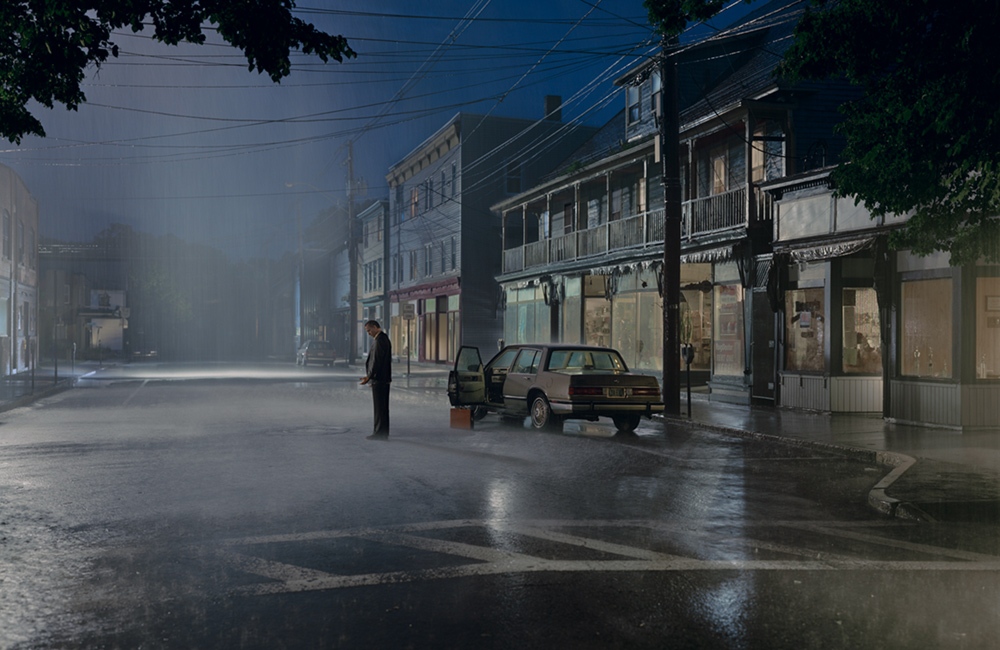

Gregory Crewdson was born in 1968 and is now a well-known photographer. He studied at Yale University and is now an instructor there. I learned about Crewdson in my photography class and I have basically fallen in love with his photos.
Crewdson has a team of nearly sixty people that work to perfect the sets for his photos. His photos are elaborately staged and sometimes super expensive to create. Most of his photos represent small town life, though they no doubt have a sci-fi feeling to them. Many of his photos are reminiscent of a colorful episode of the Twilight Zone and some say that they resemble Steven Spielberg's work because they appear somewhat cinematic.
Crewdson's elaborate sets definitely represent 21st century life. Here in the 21st century, we are all about complexity. Crewdson demonstrates complexity through his enormous, staged sets that require hundreds of hands and lots of time. Not only are his sets complex, but so are the ideas that his photos may or may not get across.
I am deeply enthralled by his somewhat perplexing photos. First, because they allow the imagination to run wild. There is no limit to what his photos might represent. For example, his series, Beneath the Roses, features an image of a woman floating face up in the water inside of a house in what looks like the den. How odd! He also has another that I deeply enjoy: a man standing outside of his car, the door is open, it's pouring rain and he's soaking wet. He's kind of feeling at the rain, as if asking, "what is this stuff?" I don't know what it means, but that's why I love it. It can mean anything!
The light in his photos is also extremely well done. Light comes in strong from all different directions, but is also lacking in all the right areas. Also Crewdson displays his photos on an extremely large scale, almost taking up full walls. This is reminiscent of today's society in a way. Everything is big nowadays... big TVs, big cars, big photographic displays... his usage of "big" is intriguing and helpful at the same time. Big photos, as opposed to one that fits into your wallet, are easier to connect and fall into. The largeness is also more realistic and lifelike. Also, Crewdson subtly places small signs and subjects into his photos that can only be seen from an extremely large scale. His talented interest for photography stems from a certain fascination that he has.
Crewdson has many times made the comment that he is intrigued with the idea of "frozen in time." Like no other media, photography has no beginning and no end. For example, books, songs, and movies all have a solid start and a finish. However, the beginning and the end are nonexistent for photographs, they just are. Crewdson definitely has a great time toying with this idea. Often, he leaves the viewer of his photos entirely perplexed, somewhat dumbfounded.
Crewdson has a team of nearly sixty people that work to perfect the sets for his photos. His photos are elaborately staged and sometimes super expensive to create. Most of his photos represent small town life, though they no doubt have a sci-fi feeling to them. Many of his photos are reminiscent of a colorful episode of the Twilight Zone and some say that they resemble Steven Spielberg's work because they appear somewhat cinematic.
Crewdson's elaborate sets definitely represent 21st century life. Here in the 21st century, we are all about complexity. Crewdson demonstrates complexity through his enormous, staged sets that require hundreds of hands and lots of time. Not only are his sets complex, but so are the ideas that his photos may or may not get across.
I am deeply enthralled by his somewhat perplexing photos. First, because they allow the imagination to run wild. There is no limit to what his photos might represent. For example, his series, Beneath the Roses, features an image of a woman floating face up in the water inside of a house in what looks like the den. How odd! He also has another that I deeply enjoy: a man standing outside of his car, the door is open, it's pouring rain and he's soaking wet. He's kind of feeling at the rain, as if asking, "what is this stuff?" I don't know what it means, but that's why I love it. It can mean anything!
The light in his photos is also extremely well done. Light comes in strong from all different directions, but is also lacking in all the right areas. Also Crewdson displays his photos on an extremely large scale, almost taking up full walls. This is reminiscent of today's society in a way. Everything is big nowadays... big TVs, big cars, big photographic displays... his usage of "big" is intriguing and helpful at the same time. Big photos, as opposed to one that fits into your wallet, are easier to connect and fall into. The largeness is also more realistic and lifelike. Also, Crewdson subtly places small signs and subjects into his photos that can only be seen from an extremely large scale. His talented interest for photography stems from a certain fascination that he has.
Crewdson has many times made the comment that he is intrigued with the idea of "frozen in time." Like no other media, photography has no beginning and no end. For example, books, songs, and movies all have a solid start and a finish. However, the beginning and the end are nonexistent for photographs, they just are. Crewdson definitely has a great time toying with this idea. Often, he leaves the viewer of his photos entirely perplexed, somewhat dumbfounded.
Crewdson's photography is both astonishing and at times unsettling. He certainly has the ability to captivate and confuse.
Wednesday, November 3, 2010
Best of Today: Sophie as a Medium
As we discussed Sophie's World in class today, we attempted to answer the question, "Why does Gaarder juxtapose the Sophie narrative with a philosophy course?" (taken from the Humanities website).
I believe that Gaarder's juxtaposition of Sophie and philosophy is a brilliant idea.
From the question, we came across some excellent explanations. First, Sophie makes the book into a novel. There are characters, like her mother and father and friends, and there are problems that Sophie has already come across... like that her mother thinks she is on drugs due to her newly found curiosity of the world around her. As readers, we are more enthralled by things that we can relate to. So, when Gaarder puts Sophie's life into this work, it provides a greater sense of affection because it is realistic, and it creates an interesting novel. Therefore, more people read it and enjoy it.
If this work was solely philosophy, I would cringe just reading the back cover. When I ponder philosophy, the words that come into my mind are "beyond me... ridiculously confusing... college... religion..." As such, philosophy, at least for me, is completely overwhelming and not something I'd like to read a book about. However, Gaarder's clever ways have put me in a slightly more discernible position: he has combined the mastery of philosophy with a fourteen year old girl who I am more or less able to relate to.
I am so happy that Gaarder has done this, that I wish I could thank him personally. I am totally thankful because this will totally help me get through this 507 page novel. I thoroughly believe that if Sophie was not a part of this work, I would be incapable of reading it. Already, I have noticed that I look forward to reading the "Sophie" parts of the novel. In a way, they give my mind a break from the intense exercise it gets from the philosophy parts.
Considering what Gaarder did, I wish that other writers would do the same. When I think about my past math and history textbooks, I probably would have understood them a lot more, and have been more motivated to read them, if there was a story line twisted into them. I honestly would not mind reading extra pages if there was more depth (like a storyline) to what I'd been reading. In the future, I'll hopefully be able to find novels like Sophie's World, that intrigue me with their fiction, yet teach me significant subjects like astronomy or psychology.
I am extremely grateful for Gaarder's unique combination of fiction and history, and I hope that it makes way for more novels like it, because it seems like an excellent way to teach and entertain at the same time.
I believe that Gaarder's juxtaposition of Sophie and philosophy is a brilliant idea.
From the question, we came across some excellent explanations. First, Sophie makes the book into a novel. There are characters, like her mother and father and friends, and there are problems that Sophie has already come across... like that her mother thinks she is on drugs due to her newly found curiosity of the world around her. As readers, we are more enthralled by things that we can relate to. So, when Gaarder puts Sophie's life into this work, it provides a greater sense of affection because it is realistic, and it creates an interesting novel. Therefore, more people read it and enjoy it.
If this work was solely philosophy, I would cringe just reading the back cover. When I ponder philosophy, the words that come into my mind are "beyond me... ridiculously confusing... college... religion..." As such, philosophy, at least for me, is completely overwhelming and not something I'd like to read a book about. However, Gaarder's clever ways have put me in a slightly more discernible position: he has combined the mastery of philosophy with a fourteen year old girl who I am more or less able to relate to.
I am so happy that Gaarder has done this, that I wish I could thank him personally. I am totally thankful because this will totally help me get through this 507 page novel. I thoroughly believe that if Sophie was not a part of this work, I would be incapable of reading it. Already, I have noticed that I look forward to reading the "Sophie" parts of the novel. In a way, they give my mind a break from the intense exercise it gets from the philosophy parts.
Considering what Gaarder did, I wish that other writers would do the same. When I think about my past math and history textbooks, I probably would have understood them a lot more, and have been more motivated to read them, if there was a story line twisted into them. I honestly would not mind reading extra pages if there was more depth (like a storyline) to what I'd been reading. In the future, I'll hopefully be able to find novels like Sophie's World, that intrigue me with their fiction, yet teach me significant subjects like astronomy or psychology.
I am extremely grateful for Gaarder's unique combination of fiction and history, and I hope that it makes way for more novels like it, because it seems like an excellent way to teach and entertain at the same time.
Friday, October 29, 2010
iMedia: Home
http://www.youtube.com/watch?v=rjFaenf1T-Y
Home- Edward Sharpe and the Magnetic Zeros
At the beginning of this past summer, I heard this song for the first time on stereomood.com. Stereomood is an excellent site that creates playlists for songs that fit into specific categories, like chillout and psychedelic. The great thing about Stereomood is that the playlists change often, always adding new songs. So, when I came back from Costa Rica at the end of the summer, my favorite song from Stereomood had disappeared and I just could not recall the name of it or the artists who sang it. I searched through thousands of songs, hoping that a name might jump out at me, but I found nothing. I was deeply saddened and aggravated by this... all I wanted was to hear my favorite song, and I just wasn't capable of finding it. And then a miracle occurred:
A couple of weeks ago, I was discussing music with a friend. I told her about my situation, and I tried to describe the bits and pieces that I could remember from my mystery song. AND SHE KNEW IT! We listened to the song on Youtube together, and I was so excited and amazed, I thought I might burst.
So... why am I entirely enthralled by and in love with this song? For starters, this song is unusual. A man and a woman sing it together, and at one part they have an actual conversation... and it's funny! They are successfully able to recount a real story, which only makes me love the song more. I also appreciate the sounds in this song. There is lots of whistling, and I adore that. Overall, the noises that this song makes pleases my ears to no end.
This piece is significant not only because of its beautiful sounds, but because of its message as well. The song basically reinstates that old saying, "home is where the heart is." Wherever these two characters go together, whenever they go, and whenever they're alone, they're home. Each one holds the others heart. As long as these two lovers are together, they feel home.
I think it's important for today's society to remember the power of love. People, especially Americans, tend to get wrapped up in their busy, meaningless lives at work and they forget how to love. They set it aside and don't realize that they're missing out on one of life's greatest pleasures. Home only reassures the fact that yes, one does need to experience love.
These two people in this song feel real. Their love is fierce, fun, and beautiful. I hope that other people can listen to this piece, and realize its strength and happiness and loveliness.
Home- Edward Sharpe and the Magnetic Zeros
At the beginning of this past summer, I heard this song for the first time on stereomood.com. Stereomood is an excellent site that creates playlists for songs that fit into specific categories, like chillout and psychedelic. The great thing about Stereomood is that the playlists change often, always adding new songs. So, when I came back from Costa Rica at the end of the summer, my favorite song from Stereomood had disappeared and I just could not recall the name of it or the artists who sang it. I searched through thousands of songs, hoping that a name might jump out at me, but I found nothing. I was deeply saddened and aggravated by this... all I wanted was to hear my favorite song, and I just wasn't capable of finding it. And then a miracle occurred:
A couple of weeks ago, I was discussing music with a friend. I told her about my situation, and I tried to describe the bits and pieces that I could remember from my mystery song. AND SHE KNEW IT! We listened to the song on Youtube together, and I was so excited and amazed, I thought I might burst.
So... why am I entirely enthralled by and in love with this song? For starters, this song is unusual. A man and a woman sing it together, and at one part they have an actual conversation... and it's funny! They are successfully able to recount a real story, which only makes me love the song more. I also appreciate the sounds in this song. There is lots of whistling, and I adore that. Overall, the noises that this song makes pleases my ears to no end.
This piece is significant not only because of its beautiful sounds, but because of its message as well. The song basically reinstates that old saying, "home is where the heart is." Wherever these two characters go together, whenever they go, and whenever they're alone, they're home. Each one holds the others heart. As long as these two lovers are together, they feel home.
I think it's important for today's society to remember the power of love. People, especially Americans, tend to get wrapped up in their busy, meaningless lives at work and they forget how to love. They set it aside and don't realize that they're missing out on one of life's greatest pleasures. Home only reassures the fact that yes, one does need to experience love.
These two people in this song feel real. Their love is fierce, fun, and beautiful. I hope that other people can listen to this piece, and realize its strength and happiness and loveliness.
Subscribe to:
Posts (Atom)